Pages

Thursday, July 10, 2014

Thursday Night Homework

Thursday Homework 13-20
By Kelly Moran


13.) Carbon is the nonmetal component of both steel and stainless steal. 

14.) Ni3Al is a well- defined alloy compound that has a low density, malleability, and is used as a component of jet aircraft engines. 

15.) Sustainability are the practices and processes of present day activities that preserve the ability of future generations to live, thrive, and meet their resource needs on Earth.

16.) a.) Reusing refers to the process of using an old object again as the same thing or changing it so that you can use it in a new affective different way. Recycling refers to the process of breaking an object down into it's rawest form and making it into something totally different.
       b.) One example of reusing is keeping the same plastic bag that you have for lunch everyday and never throwing it away. An example of recycling is throwing a plastic bag into the recycling bin where it can then be turned into a water bottle or something else totally different. 

17.) a.) Four examples of renewable resources include wood, water, fruits and vegetables, and anything that grows on a plant or tree. 
       b.) Nonrenewable resources include oil, coal, natural gases (from gas wells), and solids like gold aluminum, copper, zinc, and much more.

18.) a.) Reusing
       b.) Recycling
       c.) Reusing

19.) The life cycle of a light bulb would be similar to that of a newspaper in that they should both be recycled and are able to be made into different things since light bulbs contain glass and newspaper is wood. They are different though in that many light bulbs like fluorescent tube light bulbs are needed to be recycled in a special way and may be handled differently when recycled since they contain mercury vapor (which is neurotoxin) and are dangerous fumes. Also light bulbs and newspaper are two totally different things (one conducts electricity and shatters  and the other is a natural renewable source that tears). 

20.) Scientific law (Law of Conservation of Matter) is much different from a law that the government issues because those laws from the government are changeable but scientific law is what it is and doesn't change. The law of conservation of matter is unchangeable and is fact. 


Wednesday, July 9, 2014

Concepts from Wednesday Reading D.8- D.10

D.8- D. 10


In tonights reading, I mainly learned about alloys and renewable and nonrenewable resources. Alloys are solid solutions mixed with two or more different metallic elements. Examples include Brass, Bronze, Steel, Pewter, Mercury amalgams, 14 carat gold, and white gold. The Common Alloy Compositions and Uses table in the books lists these examples of alloys and their percent by mass of each element in the alloy. It also list each examples use in the world. Sustainability in chemistry refers to the practices and processes in our present day activities that preserve the ability of future generations to live and meet their resource needs on Earth. Renewable resources are resources that can eventually be regrown or replenished by natural processes. For example, both wood and water are renewable resources because wood grows from trees and if you plant a seed a tree will grow and a tree will regrow usually after being chopped and water is a renewable resource because it has a cycle of evaporation and going into the clouds and then back to the ocean therefore we have an endless amount of water because our water never disappears it just goes in a circle. This is what renewable resources are. They are resources that we can never loose because they are able to replenish themselves or never disappear in the first place. Nonrenewable resources are resources that cannot readily be replenished. For example, the Earth contains an infinite amount of petroleum (oil) but we still cannot replenish it because once we should oil or burn it, it is gone and not the same. Oil changes and cannot replenish itself which is why it is possible for one day the Earth to loose oil if we use all the oil in the Earth which would be a lot. 

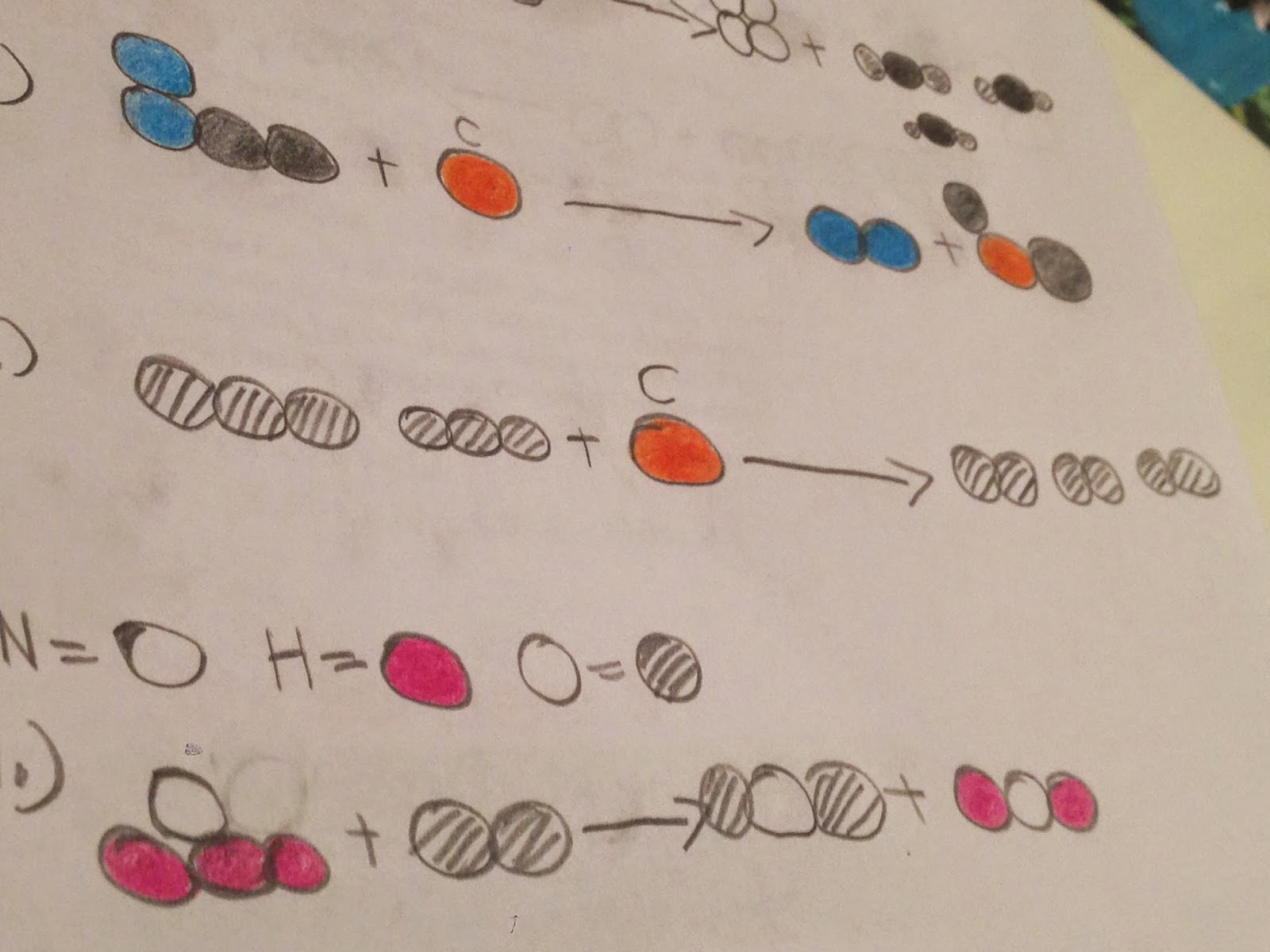
Homework Problem #8

Here are my drawing for problem #8 of the homework!


Wednesday Night Homework

Wednesday Night Homework 
By Kelly Moran

Questions 7-12 on pg. 141


7.) a.) 3 
     b.) 2
     c.) 1


 8.) a.) 1 WO3 + 3 H2 = 1 W + 3  H20
      
      b.) 2 PbS + 3 O2= 2 PbO + 2SO2

      c.) 4 Fe + 3 O2 = 2 Fe2O3


9.) a.) 1, 3, 2 3

     b.) 2, 25, 16, 18

10.) a.) Left           Right   The atoms are conserved 
             Na= 2       Na=2
             S=1          Cl= 1
             K= 2        K= 2
             Cl= 1       S=1
             O= 4        O= 4
        
        b.) No he did not because he balanced the equation by changing subscripts which is bad because that changes the identity of the compound. You can only balance a chemical equation with coefficients.

        c.) 1, 2, 2, 1 are the coefficients in this chemical equation to make it balanced.  

11.) An alloy is a solid solution mixed together with two or more different metal elements.

12.) Brass and Steel are two examples. 


Blogpost on Tuesday Night Reading

Reading Concepts for D.5-D.7
By Kelly Moran


In last night's reading, I learned a few new concepts. The law of conservation of matter is based on the notion that atoms are indestructible. The reactants in a chemical equation are on the left side of the chemical equation and are what make up the product of the chemical equation. The right side of the chemical equation is called the product and is what comes out from the reactants being combined. In order to balance out a chemical equation you cannot add a subscript but you can only add coefficients. In starting out with balancing chemical equations it is good to start with making an atom inventory. An atom inventory is when you list how many atoms of each element are in the chemical equation. Once you do an atom inventory you can see how many atoms are on the reactant side and how many atoms are on the product side therefore you can see whether the equation is balanced or not. If the equation is not balanced then you will add coefficients to the elements or compounds to make the equation balanced. Many times if the equation is difficult to balance you will have to keep having to add bigger and bigger coefficients until the equation is balanced. When creating models from chemical equations you are asked to represent elements through circles with different colors and patterns to differentiate them. When making models you must make the models symmetrical. For example, if you are to make a model of H2O, you would put the Hydrogen circles on opposite ends of the oxygen circle and have the oxygen in the middle to make it symmetrical. 

Tuesday, July 8, 2014

Tuesday Night Homework

Sections D.5-D.7 Questions
By Kelly Moran


Questions 1-6 on pg. 131


1.)

2.) 


3.)

4.)

5.) 

6.)

Questions 2, 4, 6 on pg. 140


2.) a.) NaHCO2 + HCl = NaCl + H2O+ CO2

     b.) C6H12O6 + O6 = 6CO2  + 6 H2O

4.) Scientific law is a statement based on repeated experimental observations and always implies that there is a casual relationship involving elements. 

6.) "Using up" and "Throwing away" is incorrect and misleading when considering the law of conservation of matter because no atoms or thrown away they just get changed. Even when you burn wood, it may look like it has disappeared but it has really changed into smoke, gas, or ashes. 


Penny Lab By Izzy, Kelly, and Sasha

Penny Lab
By Kelly Moran, Izzy Berrent, and Sasha Elie 
July 8, 2014

Data Table: 


Appearance of penny before
Appearance of coin after being boiled in Zinc Chloride
Appearance of penny after being heated on hot plate
Predictions
Results
Luster
Turned lighter and less defined
Became splotchy and multicolored with gold, pink, and black
We predicted the penny would not change that much in the Zinc nitrate because copper is not very reactive.
We can conclude from these observations, that copper is somewhat reactive and reacts with zinc nitrate since it changed quite a bit.
Malleable
Got silver splotches/ stains from the zinc
Also became ashy looking and looked burnt
We predicted that the penny heated on the hot plate would become burnt but not change colors since copper is not very chemically reactive.
Same with burning on the hot plate, we can conclude the copper is reactive since it’s color changed drastically from what a penny would look like normally.


Abstract: What we did (in a nutshell) was boil water with granulated Zinc for a couple minutes and then dropped the pennies inside with tongs and then took the pennies out later. We also placed a penny on the hot plate to see it's reaction to that as well. From this lab, we learned that when coins are mixed and boiled with granulated zinc, it changes it's effects and it's color. This is it's reaction. The purpose of this lab was to test how copper reacted to boiled zinc chloride and how it reacted to being burned as well. 

Procedure: We set up three pennies and cleaned them each thoroughly until they were completely clean. We then set aside one of the pennies we had cleaned (which served as the control penny). Then we weighed a sample of granulated zinc which should weigh about 2.0-2.2 grams. Ours weighed 2.14 grams. We then placed it in a 250 mL beaker and used a graduated cylinder to measure 25 ml of 1 M of Zinc Chloride solution. We then added the zinc chloride to the granulated zinc that was in the beaker. Then we covered the beaker and placed it on a hot plate with a watch glass on top. We heated the beaker and waited until it began to bubble inside and then we lowered the temperature to sustain the gentle bubbling. Then we removed the watch glass and removed the two coins and then rinsed them under water and then dried them. We then put one coin on the hot plate at medium heat and turned it every 5 seconds until we saw drastic color changes. Then we rinsed the coin under tap water and recorded our observations. Lastly we compared all the pennies to each other and recorded all the information on our data table.

Results: In our results we found that the penny that was boiled in zinc chloride had reacted to the solution because it had a physical change. The physical change was that it became pinker and less defined. It also got silver stains on the penny as well. We can concluded from this observation that this penny was chemically reactive to zinc chloride and if in it longer may have reacted even more drastically. We also found that the penny that we placed on the hot plate and flipped like bacon back and forth every five seconds became multicolored with splotches of gold, pink, and black. It also turned ashy and looked completely burnt in some areas. We can also conclude from this observation the copper is chemically reactive and physically reactive to heat. 


Questions 1-6

1.) The untreated remained the normal color of a penny. The penny heated in zinc chloride solution and became lighter and less defined. The penny that was heated in zinc chloride solution and then turned over a series of times every five seconds on the hot plate became splotchy and had a gold color to it.

2.) Yes because the pennies chemically reacted to the chemicals therefore they must have been a metal. 

3.) You could test the metal and record how much it reacts. If it doesn't react a lot then it would be a precious metal. 

4.) Some of the copper atoms disappeared. I am not sure where the copper atoms went because the solution (zinc chloride) did not change when we put the pennies in it but the pennies did change. They both turned pinker and lighter and developed stains of silver. It is possible that some of the copper atoms left the penny and went into the zinc chloride solution although the solution did not react to the copper atoms.

5.) Two practical uses for metallic charges include lighting because that involved conducting heat and the copper reacted to heat and another use would be metallic charges in batteries. The copper (plus charge) acts with the zinc (negative charge) in batteries. 

6.) I don't think that the treated pennies could ever go back to normal form. It is possible that with a certain solution the pennies could physically change to look normal again but I don't think everything would be the exact same as it was originally. 

Here are some pictures from our beautiful lab! 


                                         1st: Reg Penny  2nd: Penny       3rd: Penny reaction from heat
                                                                    from Zinc Chloride 


The End!